
Most photographers start their business without a real contract. They use a handshake, a text message, or a basic email confirmation and hope for the best. Then something goes wrong, and they realize how exposed they were the whole time.
A photography contract is not a formality. It is the document that protects your income, sets expectations with clients, and gives you legal standing if something goes sideways. It also makes you look like a professional who has their business together, which matters more than most people think.
Here is exactly what your contract needs to include and why each section matters.
Why Every Photographer Needs a Contract
Even with the nicest clients, things can go wrong. A wedding gets postponed. A client disputes the number of edited photos. Someone asks for a full refund after the shoot. Without a contract, you have no legal protection and no clear framework to resolve the dispute.
A contract does three things for your business:
- It protects your income. Your cancellation and refund policies are only enforceable if they are in writing and agreed to before the job.
- It sets clear expectations. Clients who know exactly what they are getting are happier clients. Surprises cause disputes.
- It elevates your brand. A polished, branded contract signals that you are a serious professional, not someone running a side hustle.
The rule: Never show up to a shoot without a signed contract and a paid deposit. Both together. Neither one alone is enough.
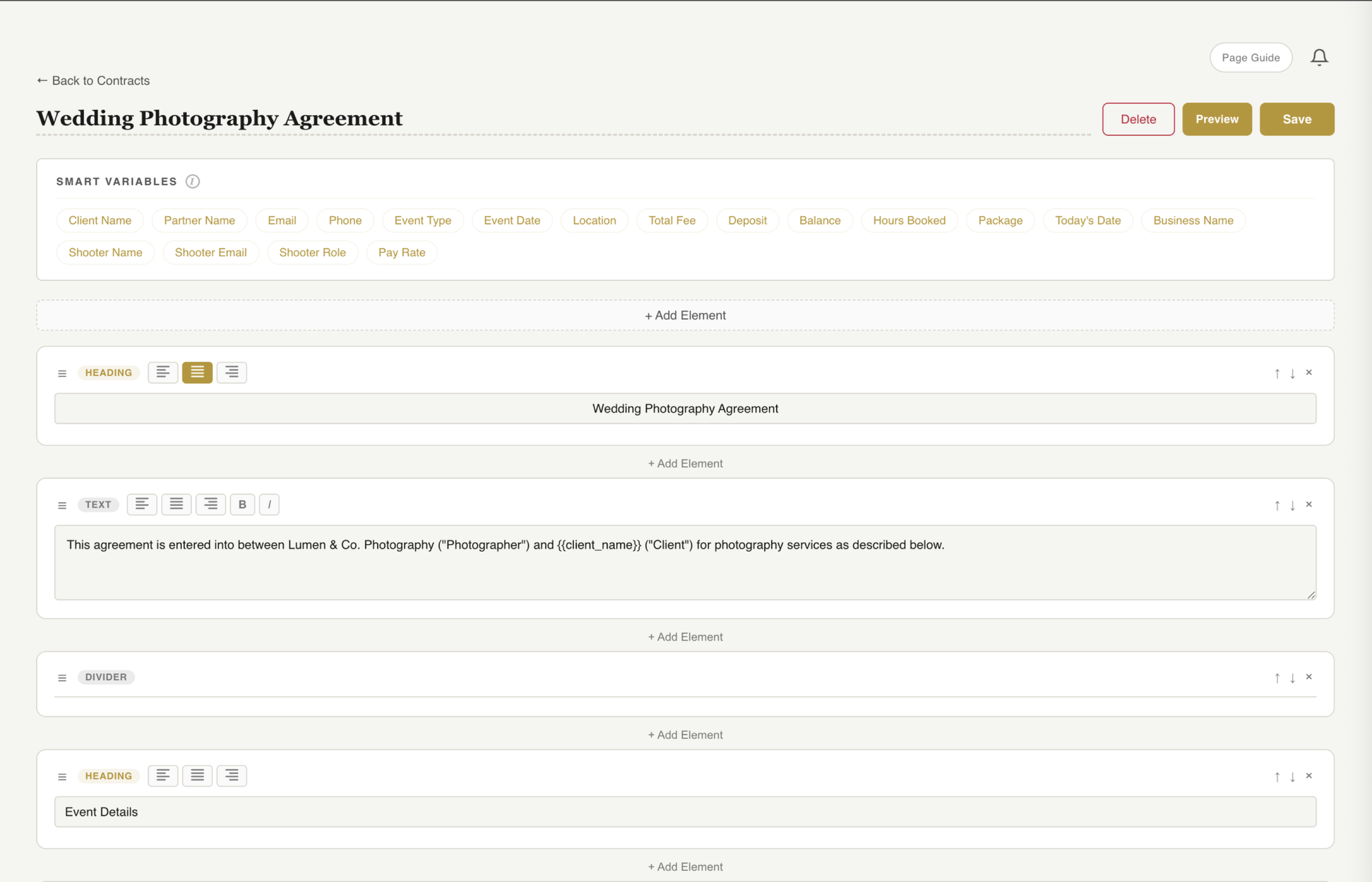
See how fstop's contract editor works →
What to Include in Your Photography Contract
1. Names and Contact Information
Start with the basics. Full legal names of both parties, contact information, and the date the contract is signed. This establishes who the agreement is between and when it was made.
2. Event or Session Details
Be specific. Include the date, start time, end time, and exact location. For weddings, list each location if there are multiple (ceremony, reception, portraits). Vague details lead to misunderstandings.
3. Services and Deliverables
Spell out exactly what the client is getting:
- How many hours of coverage
- How many edited photos they will receive
- The delivery format (online gallery, USB, both)
- The expected turnaround time
- Whether a second shooter is included
- Any add-ons they have purchased (albums, prints, video)
The more specific you are here, the fewer questions you will get later.
4. Pricing and Payment Schedule
List the total amount, the deposit required to hold the date, and when the remaining balance is due. Most photographers require the final payment one to two weeks before the event. Waiting until after the shoot is a mistake you only make once.
5. Cancellation and Refund Policy
This is the section most photographers skip and then regret. Be clear about what happens if the client cancels. A common structure looks like this:
- Deposit is non-refundable in all cases (it compensates you for holding the date)
- Cancellation 60+ days before the event: deposit forfeited, remaining balance waived
- Cancellation within 60 days: 50% of the remaining balance is due
- Cancellation within 30 days: full remaining balance is due
Adjust the specifics to fit your business, but the key is having a clear policy that clients agree to upfront.
6. Rescheduling Policy
Life happens. Couples postpone. Have a clear policy for what happens when a client wants to move their date. Common approaches include allowing one free reschedule with availability, or applying the deposit toward a new date within a set window.
7. Copyright and Usage Rights
You own the photos you take. That is the default under copyright law. Your contract should state this clearly and specify what rights you are granting the client. Most photographers give clients personal use rights, which means they can print, share, and use the photos for non-commercial purposes but cannot sell them or use them in advertising without your permission.
Also include whether you have the right to use the photos for your portfolio, website, and social media. Get this in writing.
8. Model Release
If you plan to submit work to publications, enter contests, or use images for marketing beyond your own portfolio, include a model release. This gives you explicit permission to use the images for those purposes.
9. Limitation of Liability
This protects you from worst-case scenarios. If your camera fails, your memory cards are corrupted, or there is an unforeseeable emergency, this clause limits your liability to the amount the client paid you, rather than opening you up to unlimited damages. It is not a guarantee you will never be sued, but it significantly limits your exposure.
10. Force Majeure
Unexpected events happen. Natural disasters, illness, venue closures, government restrictions. A force majeure clause outlines what happens when events outside your control prevent the shoot from happening. This became especially important for photographers who had no such clause when mass cancellations happened in 2020.
11. Governing Law
Specify which state's laws govern the contract. This matters if there is ever a dispute that escalates to legal action.
Photography Contract Checklist
- Names and contact info for both parties
- Event date, time, and location(s)
- Services and deliverables (hours, photo count, turnaround)
- Total price, deposit amount, and payment due dates
- Cancellation and refund policy
- Rescheduling policy
- Copyright ownership and client usage rights
- Your right to use images for portfolio and marketing
- Model release (if applicable)
- Limitation of liability
- Force majeure clause
- Governing law
- Signature lines and date
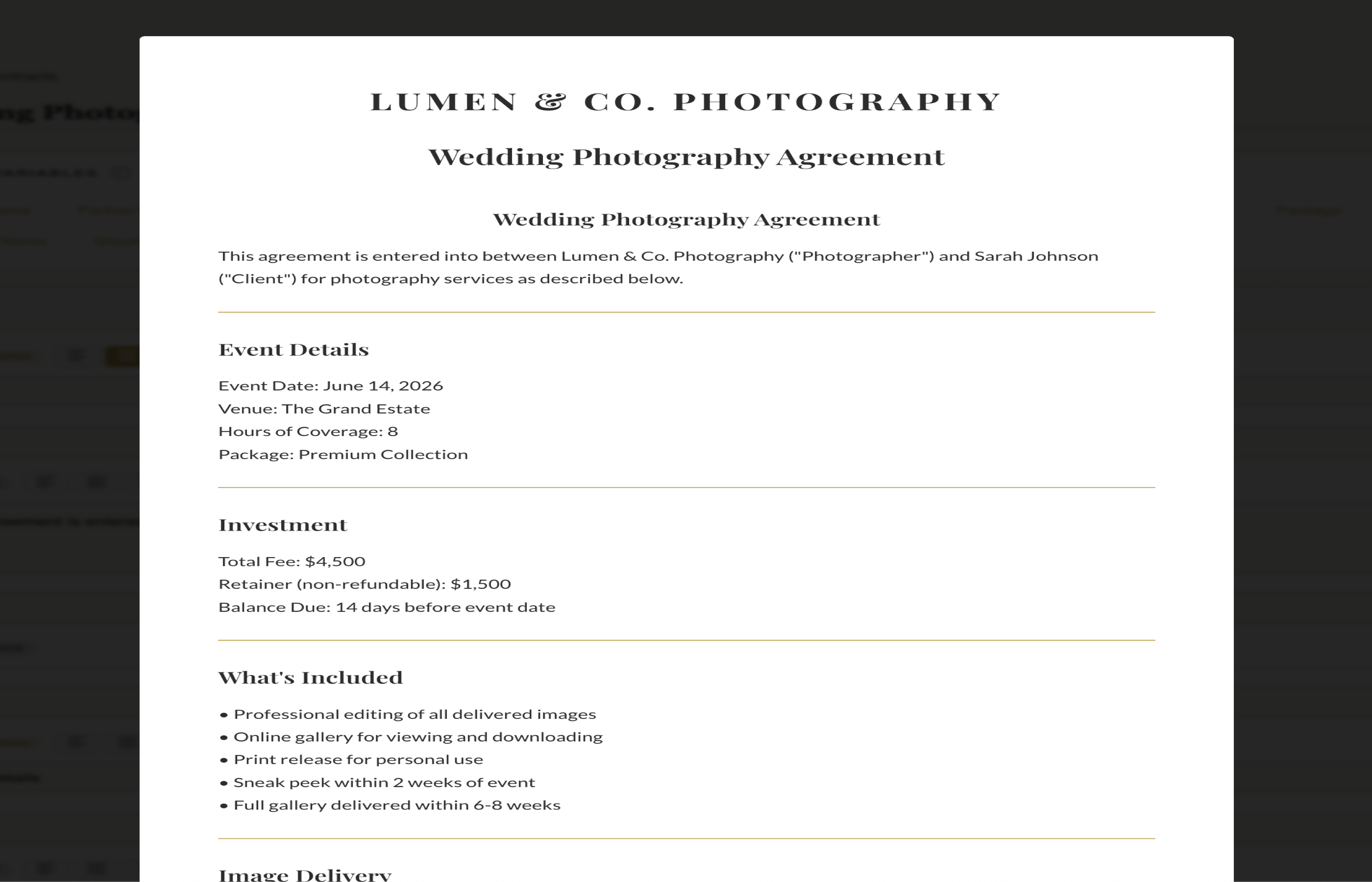
See how fstop's contract preview works →
Make It Easy to Sign
A contract that requires printing, signing, scanning, and emailing back is a contract that slows down your bookings. In 2026, there is no reason your clients should have to leave their couch to sign a document.
Digital contracts with e-signatures are legally binding in all 50 states and most countries. They also convert faster. When a client can review and sign from their phone in two minutes, you close the booking before they have time to second-guess it.
With Fstop, you can build branded contracts with your logo and colors, include all the clauses above, and send them for e-signature in minutes. When a client signs, it automatically saves to their profile so everything stays organized in one place. No back-and-forth emails, no chasing down signatures, no paperwork lost in your inbox.
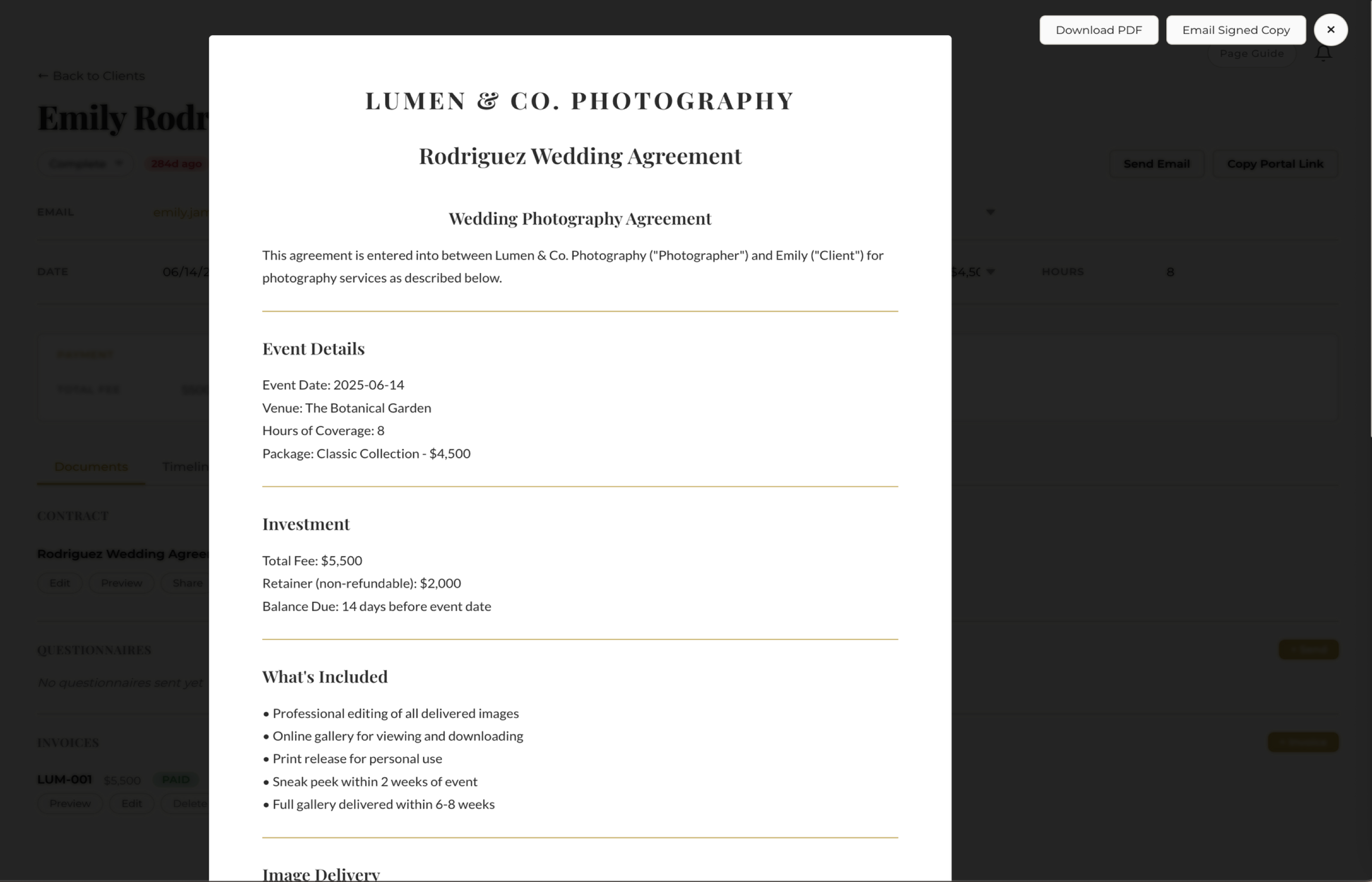
See how fstop's e-signatures work →
Keep It Professional, Not Intimidating
Some photographers worry that a detailed contract will scare clients off. The opposite is true. Clients who are serious about hiring you will appreciate that you are professional and organized. The ones who push back on a contract are usually the ones who would cause problems anyway.
Your contract does not need to read like it was written by a lawyer. Use plain language where possible. Explain the why behind important clauses. A sentence like "Your deposit holds your date exclusively and cannot be refunded because we turn away other clients once you book" is more effective than dense legalese.
The goal is a document that protects you and reassures your clients that they are in good hands.
Build your contract in minutes.
Fstop's contract builder lets you create branded, professional contracts with e-signatures. No templates to copy, no PDFs to email. Just sign and book.
Try Fstop Free