The difference between a smooth wedding day and a stressful one almost always comes down to preparation. Not gear. Not talent. Preparation. And the single most important preparation tool in your kit isn't a lens or a lighting setup -- it's a well-crafted client questionnaire.
A good questionnaire does three things: it gets you the information you need to shoot confidently, it sets expectations with your clients before the big day, and it makes the couple feel like you genuinely care about their story. That last part is what turns clients into raving referrals.
Below are 50 questions organized into six categories. You don't have to use every single one -- pick the questions that matter for your shooting style and your clients. But this is the complete list, and most experienced wedding photographers will tell you they wish they'd asked more, not less.
1. About the Couple (8 Questions)
These questions help you understand who you're photographing -- not just what they look like, but who they are together. This context shapes how you tell their story.
- How did you two meet? This gives you narrative context. If they met at a coffee shop, and there's a coffee cart at the reception, you'll know to capture that detail.
- Tell us about your proposal -- who proposed, and how did it happen? Engagement stories often hint at what the couple values most: intimacy, humor, surprise, family involvement.
- How would you describe your relationship in three words? This is surprisingly revealing. "Adventurous, silly, loyal" suggests a very different shooting approach than "elegant, classic, romantic."
- What are you most excited about on your wedding day? Whatever they answer, make sure you're ready to photograph it beautifully.
- Is there anything you're nervous about on the wedding day? This lets you address concerns proactively. If they're nervous about posed photos, you can adjust your approach.
- What photography style are you drawn to? (light and airy / dark and moody / classic and timeless / documentary / editorial) Even if you discussed this during booking, confirm it. Preferences shift between inquiry and the wedding day.
- Are there any must-have photos or moments you'd be disappointed to miss? Every couple has a non-negotiable. Maybe it's grandmother's ring, maybe it's the father-daughter dance. Know before you go.
- Is there anything we should know about either of you that would help us photograph you better? Open-ended on purpose. This is where you learn about insecurities ("I don't like my left side"), physical considerations, or personal details that matter.
2. Wedding Day Details (10 Questions)
Logistics make or break your timeline. These questions prevent the "nobody told me" moments that eat into portrait time.
- What is the ceremony venue name and address?
- What is the reception venue name and address? (If different from ceremony.)
- What time is the ceremony scheduled to begin?
- What time does the reception start? When does it end?
- Where will the bride/partner 1 be getting ready? (Venue name and address)
- Where will the groom/partner 2 be getting ready? (Venue name and address)
- Are you doing a first look? If yes, what time and where? This single question reshapes your entire timeline. Know it early.
- Is the ceremony indoors or outdoors? Is there a backup plan for weather?
- Are there any venue restrictions we should know about? (No flash, limited access areas, time limits, noise curfews)
- What is your wedding day color palette or theme? Helpful for knowing what to expect visually and for styling flat lays.
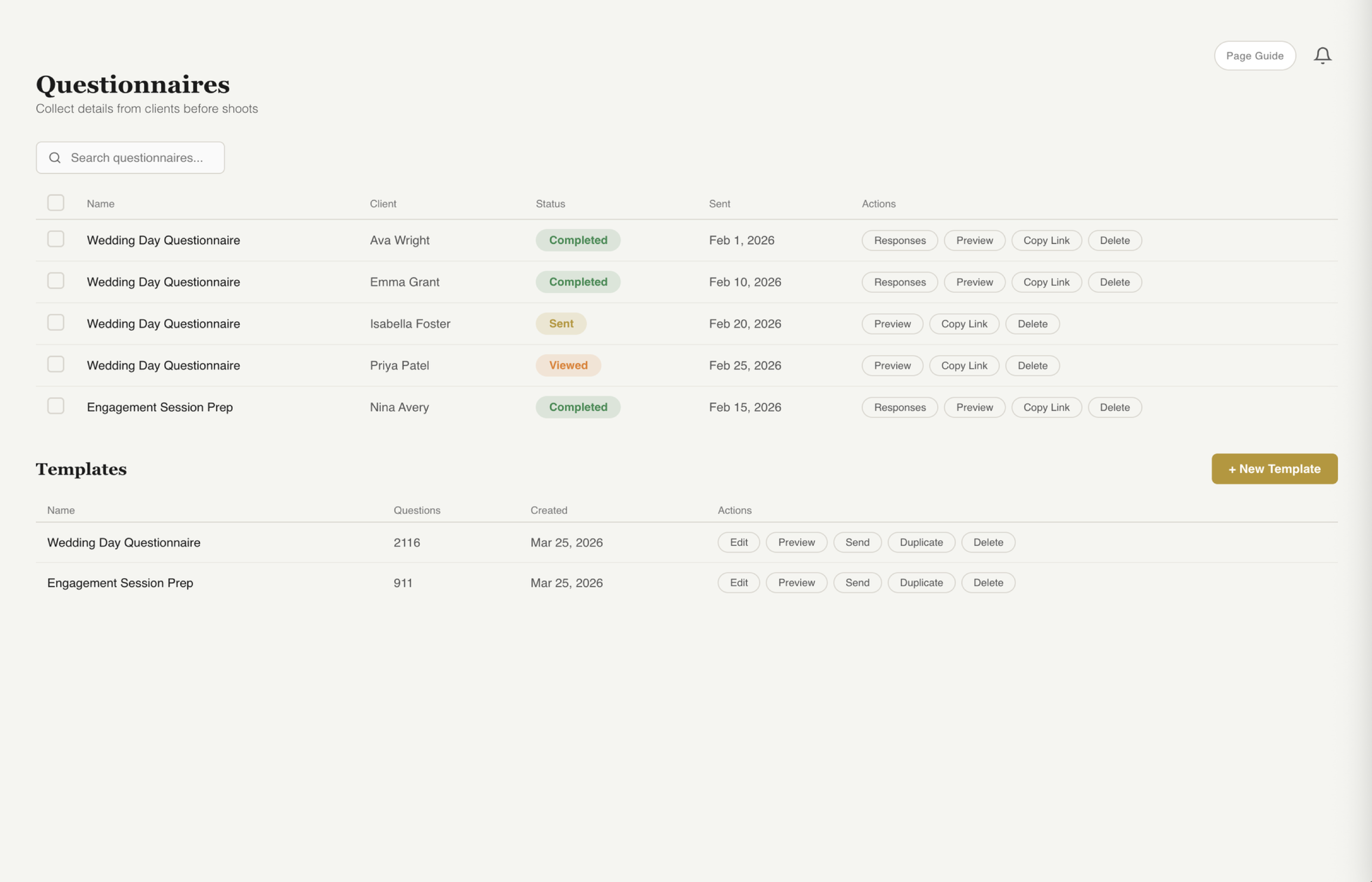
See how fstop's questionnaire feature works →
3. Family & Wedding Party (8 Questions)
Family formals are the most time-sensitive part of the day. The better your list, the faster you move -- and the happier everyone is.
- How many bridesmaids/attendants do you have? Please list their names.
- How many groomsmen/attendants do you have? Please list their names.
- Please list the family formal groupings you'd like photographed. Example: Couple + bride's parents, couple + groom's parents, couple + both sets of parents, couple + siblings, etc. Provide a template list they can edit.
- Are there any divorced parents, stepparents, or family dynamics we should be aware of? This is the single most important family question. Knowing that the bride's parents are divorced and shouldn't be in the same photo prevents an incredibly awkward moment.
- Are there any VIPs or special guests we should know to photograph? Grandparents who traveled internationally, a friend who's battling illness, the couple's mentor -- people who matter but aren't in the wedding party.
- Is there a flower girl or ring bearer? Ages? Kids under 5 need a very different approach than kids who are 8-10.
- Will there be a wedding planner or day-of coordinator? Name and contact number? Your best ally on the wedding day. Get their info early and connect before the event.
- Are there other vendors we should coordinate with? (Videographer, DJ, florist) Especially the videographer. You need to know each other's shot lists and stay out of each other's frames.
4. Photography Preferences (8 Questions)
This section is where you dial in the creative direction. Even couples who said "just capture the day naturally" usually have stronger preferences than they realize.
- On a scale of 1-10, how comfortable are you in front of a camera? This tells you how much warming up they'll need during portraits. A "3" means you should plan extra time and have prompts ready.
- Do you prefer more posed/directed photos, more candid/documentary photos, or a mix of both?
- Do you have a preference on black and white photos? (Love them / a few is fine / prefer all color)
- Are there specific detail shots you'd like? (Rings, shoes, invitation suite, perfume, heirlooms, etc.)
- Are there any photos you've seen on Pinterest or Instagram that you'd love to recreate? Ask them to share a folder or board. Reference images are worth a thousand words.
- Are there any photos or poses you specifically do NOT want? Some couples hate the "looking at each other and laughing" pose. Some despise the garter toss shot. Better to know now.
- Would you like photos of the ceremony rehearsal or rehearsal dinner?
- Do you want us to photograph the reception exit/send-off? (Sparklers, confetti, etc.) What time?
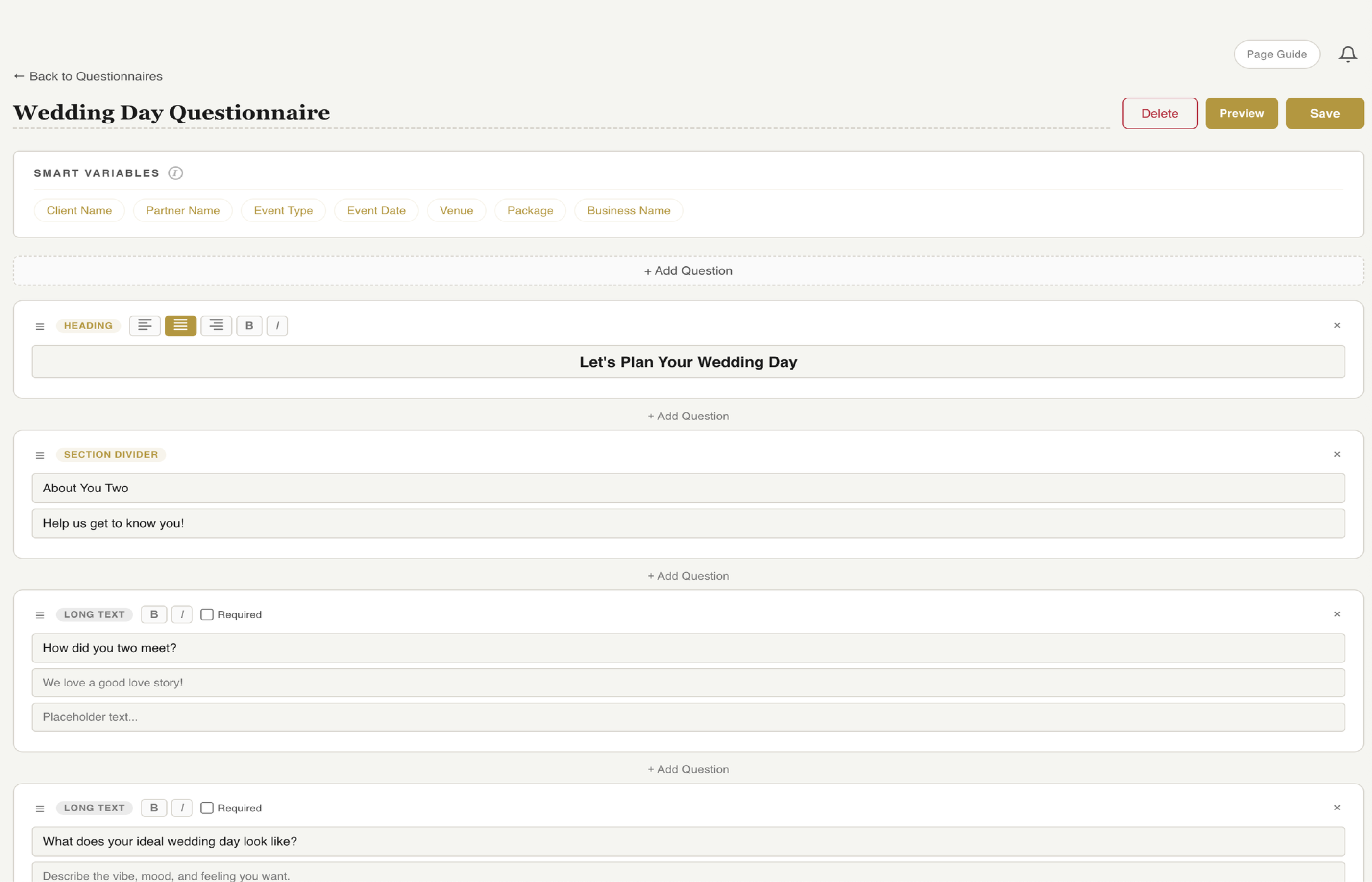
Build and send branded questionnaires with fstop →
5. Timeline & Logistics (8 Questions)
These questions directly shape the timeline you build for the wedding day. The more specific, the better.
- How much time would you like set aside for couple portraits? Suggest a minimum (usually 30-45 minutes) but let them choose. Some couples want an hour; others want 20 minutes and back to the party.
- Are you open to golden hour portraits? (Stepping away from the reception briefly for sunset photos) Golden hour is often the best light of the day. If they're open to it, build it into the timeline.
- Is there a specific location you'd like to use for portraits? A park nearby, a favorite spot in the city, a specific area of the venue grounds.
- How much time should we plan for family formal photos? Guide them here. Most photographers need 15-20 minutes for a standard family list, 30+ for extended families.
- What time will hair and makeup begin? How many people are getting hair and makeup done? This determines your getting-ready arrival time. If 8 people are getting makeup, the last person finishes much later than the first.
- Is there a cocktail hour? What time and where? Cocktail hour is usually when you shoot couple and wedding party portraits. Knowing the timing is essential.
- Will a vendor meal be provided for the photography team? If so, when during the reception? This matters for timeline planning. If you eat during speeches, you miss the speeches. If you eat during dancing, you miss the party. Coordinate it.
- Is there parking available at the venue? Any parking passes or restrictions? Arriving 10 minutes late because you couldn't find parking is a terrible way to start a wedding day.
6. Delivery & Expectations (8 Questions)
Setting clear expectations before the wedding prevents uncomfortable conversations after. These questions protect both you and the client.
- Are you aware of the estimated delivery timeline for your gallery? (Restate your turnaround time here.) Even if it's in your contract, restate it. "Just to confirm, your gallery will be delivered within 6-8 weeks of your wedding date."
- Do you have a preference for how many final images you receive? Some couples want 800+ images. Others want a curated 400. Knowing their expectation avoids disappointment.
- Are you comfortable with us sharing your photos on our website and social media? Get explicit consent. And if there are privacy concerns (public figures, surprise elements), note them.
- Do you plan to share sneak peeks or wedding photos on social media? If so, is there a specific hashtag?
- Are you interested in a wedding album? If so, do you have a page count or budget in mind?
- Are you interested in printed products? (Canvases, framed prints, parent albums)
- Would you like an engagement session? (If not already discussed/booked)
- Is there anything else you'd like us to know that we haven't covered? Always end with an open question. The best details often come out when clients aren't prompted with a specific category.
Pro tip: Don't send all 50 questions as one massive form. Pick the 25-30 that matter most for your shooting style and your typical client. A questionnaire that takes 15 minutes to fill out gets completed. One that takes 45 minutes gets abandoned halfway through.
How to Send Your Questionnaire
A great questionnaire is useless if it never gets filled out. The delivery method matters almost as much as the questions themselves.
Option 1: Build it in your CRM
If you're using a CRM like Fstop, you can build your questionnaire directly in the platform. The advantages are significant: it's branded with your logo and colors, responses are automatically attached to the client's profile, you can track who's completed it and who hasn't, and you can send reminders with one click.
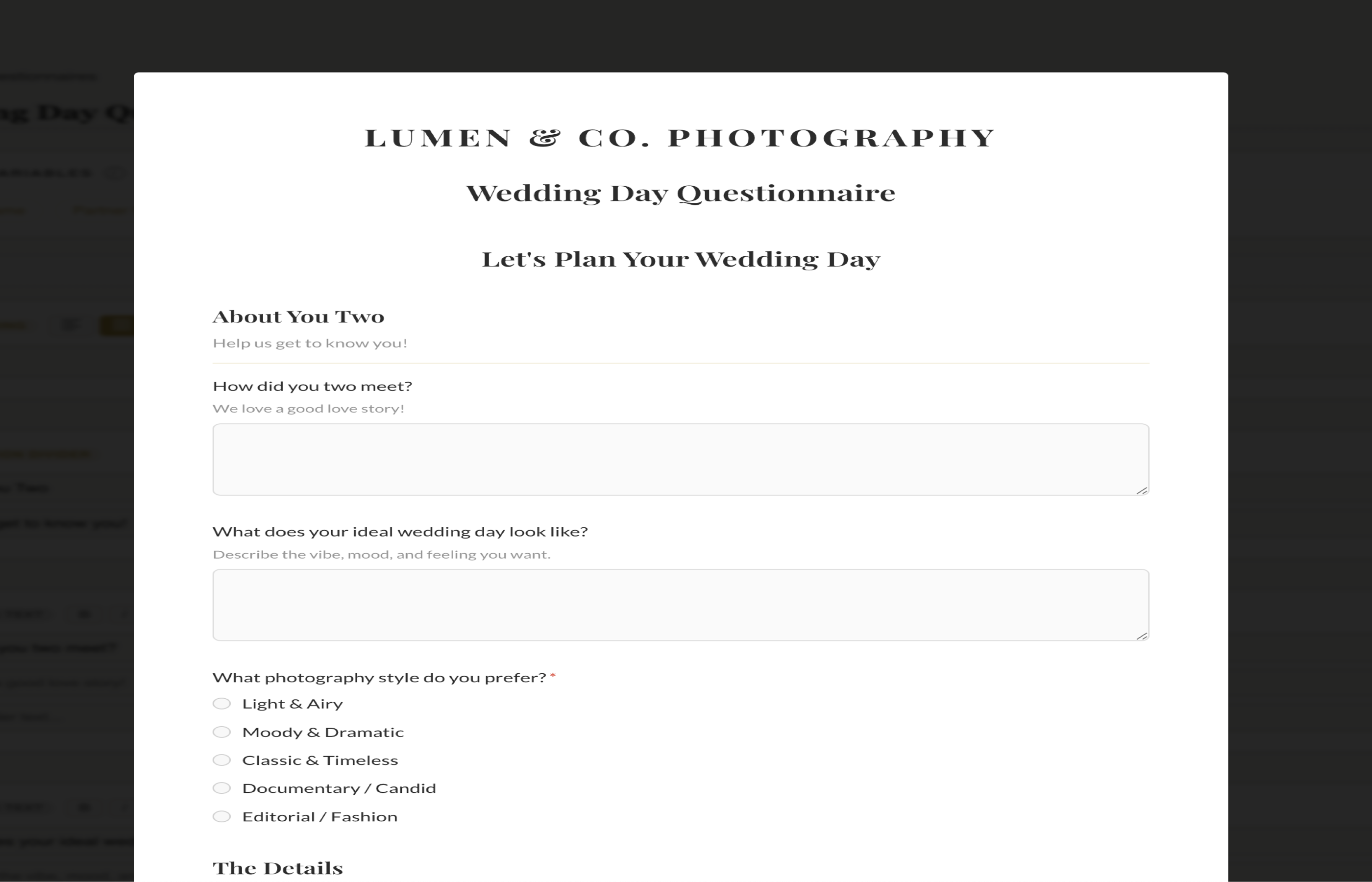
See how fstop's questionnaire feature works →
Option 2: Google Forms
Free and functional. The downside: it's not branded, responses live in a separate spreadsheet, and there's no connection to the rest of your client workflow. If you're just starting out and don't have a CRM yet, Google Forms works. But you'll outgrow it.
Option 3: PDF or email
Some photographers still email a PDF or a bulleted list. It works in a pinch, but responses come back in every format imaginable -- some reply inline, some retype into a new email, some print it and take a photo with their phone. Consolidating the information takes more time than it should.
When to Send Your Questionnaire
The sweet spot is 2-4 weeks before the wedding. Here's why:
- Too early (3+ months out) -- they don't have final details yet. Venue layout, vendor contacts, and family lists are still in flux.
- Too late (less than 1 week) -- they're stressed, overwhelmed, and less likely to give thoughtful answers.
- Just right (2-4 weeks) -- details are locked in, they're excited but not yet panicking, and there's still time to follow up if needed.
Pro Tips for Higher Completion Rates
A questionnaire only works if your clients actually fill it out. Here's what experienced wedding photographers have learned:
- Set a deadline. "Please complete by [date 2 weeks before the wedding]" gets far more responses than "whenever you get a chance." People need a gentle deadline.
- Keep it under 15 minutes. Time yourself filling it out. If it takes you more than 15 minutes to read through and answer, it's too long. Cut the questions that are nice-to-know but not need-to-know.
- Explain why each section matters. "This helps us build your timeline" and "this prevents awkward moments during family photos" shows clients that the questions have a purpose.
- Follow up if it's not completed. Send a friendly reminder 5-7 days after sending. Something like "Just a quick nudge -- your questionnaire is still waiting. Filling it out helps me make sure your wedding day photography is exactly what you're hoping for."
- Make it mobile-friendly. Most couples will fill this out on their phones, probably on the couch after dinner. If your questionnaire requires a desktop computer, completion rates drop dramatically.
- Use it to build the timeline. Don't just collect the answers -- turn them into your wedding day timeline. When clients see that their questionnaire directly shaped the plan for their day, they understand the value immediately.
Turning Questionnaire Answers Into a Wedding Day Plan
The questionnaire isn't just a form -- it's the raw material for your entire wedding day strategy. Here's how experienced photographers use the responses:
- Build the timeline from ceremony time, first look decision, portrait preferences, and reception schedule
- Create the shot list from must-have moments, family groupings, and detail requests
- Plan your gear based on indoor/outdoor settings, venue restrictions, and exit send-off details
- Prep for personalities -- a camera-shy couple needs a different approach than one that's excited to pose
- Coordinate with vendors using the planner/coordinator and videographer contact information
- Set delivery expectations so there are no surprises after the wedding
In Fstop CRM, questionnaire responses feed directly into the client's profile. When you build the timeline, the information is right there -- no switching between tabs or digging through emails. The golden hour calculation uses the actual venue location and wedding date, so you know exactly when to step outside for sunset portraits.
This is the kind of detail that separates a photographer who shows up prepared from one who's figuring things out on the fly. Your clients might not notice the system behind it, but they'll absolutely notice the result: a smooth, stress-free wedding day and photos that feel intentional, not improvised.
Build and Send Questionnaires With Fstop
Create branded questionnaires, track responses, and turn them into wedding day timelines -- all in one place. 7-day free trial, cancel anytime.
START YOUR TRIAL