A wedding day without a timeline is a wedding day that runs behind. It sounds dramatic, but after you've photographed a few dozen weddings, the pattern is unmistakable: when there's no written timeline, everything takes longer than anyone expects, golden hour slips away during family formals, and the couple ends up with 40 fewer minutes of portrait time than they were counting on.
The good news is that building a solid day-of timeline isn't complicated. It just takes a framework, a little math, and the willingness to be honest about how long things actually take. This guide walks you through the process step by step, includes a sample timeline you can adapt for your own weddings, and covers the mistakes that derail even experienced photographers.
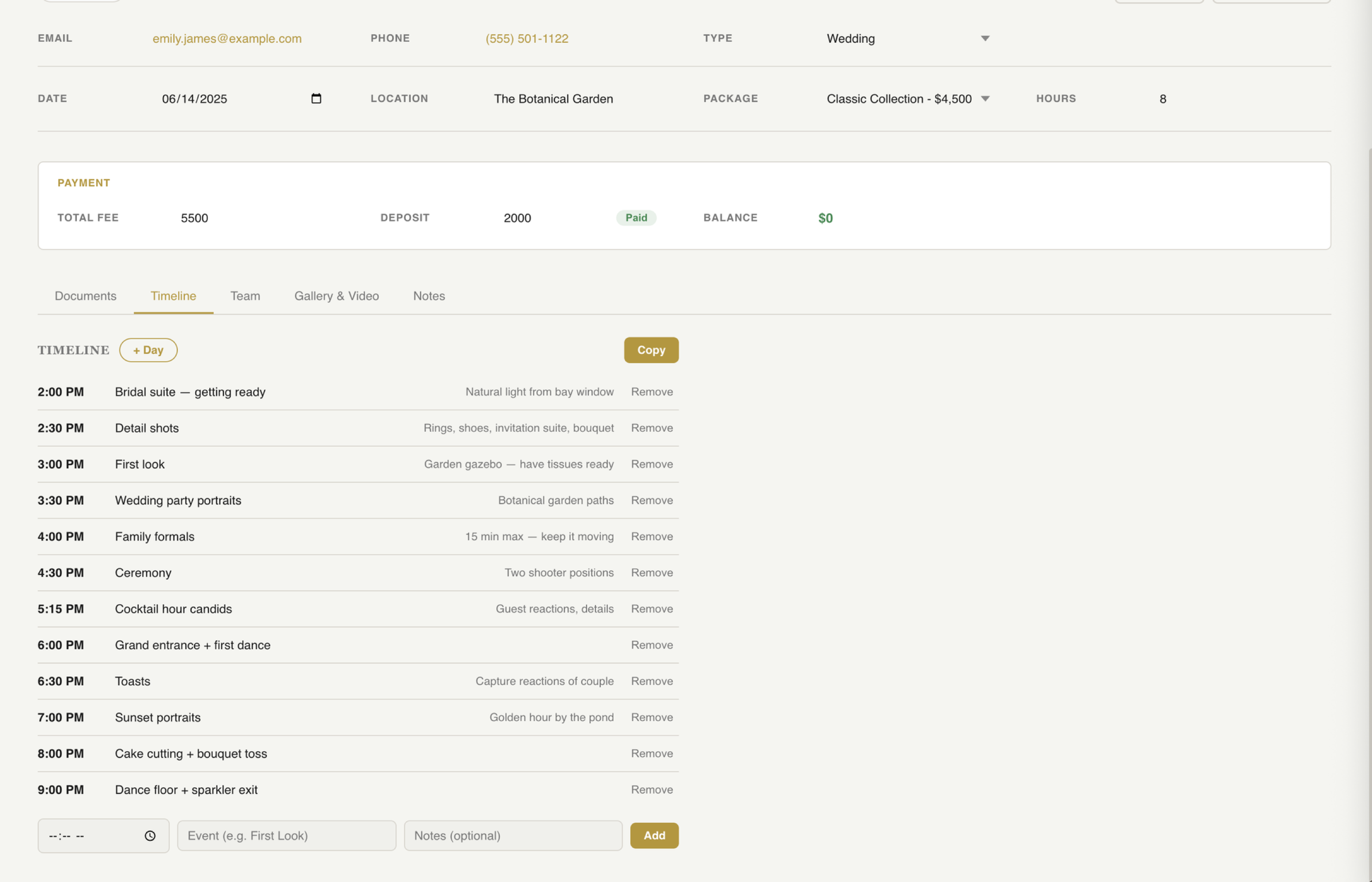
See how fstop's timeline builder works →
Why Every Wedding Needs a Written Timeline
Couples often assume the day will just "flow." And it might — if there are six people at a backyard ceremony. But the moment you add a bridal party, extended family, a venue coordinator, a DJ, a florist, and a caterer, you have a dozen people who all need to know where to be and when. The timeline is the document that keeps everyone synchronized.
For photographers specifically, the timeline determines your shot list. If you don't know when the couple is doing their first look, you can't plan where to position yourself for the best light. If family formals aren't blocked out, they'll happen in a chaotic rush after the ceremony while Uncle Jerry wanders off to the bar. The timeline protects portrait time — and portrait time is what couples care about most when they look at their gallery months later.
A written timeline also sets expectations. When everyone can see that there are exactly 20 minutes for family formals, the family understands they need to be present and ready. When the DJ sees the reception schedule, they know when to cue the first dance. No guessing, no "I thought we had more time."
Start With the Ceremony and Work Backwards
The ceremony time is the one immovable anchor on a wedding day. Everything else revolves around it. So that's where you start — then work backwards to figure out when getting ready needs to begin, and forwards to plan the reception.
Here's the logic: if the ceremony is at 4:00 PM and you want a first look at 2:45 PM, that means the couple needs to be fully dressed and ready by 2:30 PM at the latest. Hair and makeup for a bride typically takes 2 to 3 hours (longer with a large bridal party), which means hair and makeup should start by 12:00 PM at the latest. Add 30 minutes of buffer, and you're looking at an 11:30 start if you want to be safe.
This backwards math is the single most useful tool in timeline building. Every block of time should be justified by what comes after it, not by a vague guess.
Getting Ready: Build in 2-3 Hours
Getting ready is the part of the day that runs long most often. Hair and makeup artists are working on multiple people, someone's dress has 47 buttons, the groomsmen can't figure out the boutonnieres. Plan for it.
For most weddings, you should block 2.5 to 3 hours from when hair and makeup starts to when the bride is fully dressed and ready for photos. If it's a large bridal party (6+ bridesmaids), lean toward 3 hours or ask the hair and makeup artist directly — they know their pace better than anyone.
As the photographer, you don't need to be there for the entire getting-ready window. Arriving 1 to 1.5 hours before the ceremony gives you time to capture detail shots (rings, invitation suite, shoes, dress), getting-ready candids, and the final moments of preparation. If the couple is doing a first look, arrive earlier — you'll need time to scout the location and get set up.
The Ceremony
Most wedding ceremonies run 20 to 30 minutes. Religious ceremonies can go longer — a full Catholic mass is often 45 minutes to an hour. Ask the officiant ahead of time so you can plan accurately.
Build in 15 minutes before the ceremony for processional staging and last-minute adjustments, and know that the ceremony itself will start 5 to 10 minutes late almost every time. Don't let this surprise you or throw off the rest of the day — it's built into the culture of weddings at this point.
Family Formals and Couple Portraits
This is where timelines live or die. Family formals are the single most underestimated block of time on a wedding day. Photographers routinely plan 15 minutes and end up spending 30. Here's why: people wander off, the family list is longer than expected, Grandma needs to sit down between shots, and someone always needs to be tracked down.
For a realistic plan, budget 20 to 30 minutes for family formals depending on the size of the family list. Create the list with the couple ahead of time and number each grouping. When the moment comes, work through the list in order — no improvising.
Couple portraits should get their own dedicated block, separate from family formals. Aim for 20 to 30 minutes minimum. This is the time that produces the hero shots for the gallery, the images that end up printed on walls. Don't shortchange it.
The single biggest timeline mistake: not accounting for travel time between locations. If the ceremony venue is 15 minutes from the portrait location, that's 30 minutes round-trip that needs to be on the timeline. Forgetting this is how golden hour portraits disappear.
Cocktail Hour and Golden Hour
Cocktail hour is the photographer's secret weapon. While guests are occupied with drinks and appetizers, you have the couple (mostly) to yourself. This is prime time for relaxed couple portraits — the formal pressure is off, the ceremony nerves have faded, and the couple is genuinely happy.
If the venue has good outdoor light, check what time golden hour falls on the wedding date. For a summer wedding, golden hour might not start until 7:30 PM. For a fall or winter wedding, it could be as early as 4:30 PM. Plan sunset portraits accordingly — sometimes that means pulling the couple away from the reception for 10 to 15 minutes, which is worth mentioning in the timeline so the DJ and coordinator know.
A quick note: golden hour happens whether or not it's on your timeline. If it's not on the timeline, you'll miss it. If it is, you won't. Put it on the timeline.
Reception Events
The reception has its own rhythm: entrance, first dance, toasts, dinner, cake cutting, dancing, and exit. The order can vary, but the key is that each event needs a time slot and the DJ or emcee needs a copy of the schedule.
A few rules of thumb for reception timing:
- Grand entrance + first dance: 10-15 minutes. Do these back-to-back while energy is high.
- Toasts: 15-20 minutes. If there are more than 3 speakers, warn the couple it'll run long.
- Dinner: 45-60 minutes for plated, 30-45 for buffet. Buffet is faster but harder to predict.
- Cake cutting: 5 minutes. Quick moment, easy to miss if you're not watching for it.
- Dancing: At least 1.5-2 hours. This is what guests remember.
- Exit: 10-15 minutes to stage (sparklers, ribbons, confetti, etc.).
Don't stack toasts and dinner too close together. Guests need a few minutes to settle into their seats and get food before speeches start. And always build 5 to 10 minutes of buffer between major events — transitions take longer than anyone plans for.
Sample Timeline: 4:00 PM Ceremony
Here's a complete day-of timeline for a wedding with a 4:00 PM ceremony and a first look. Adapt the times to fit your ceremony start, but keep the spacing between events roughly the same.
- 12:00 PMHair & makeup begins
- 1:30 PMPhotographer arrives — detail shots and getting-ready candids
- 2:00 PMGetting ready portraits (bride in dress, groom final prep)
- 2:45 PMFirst look
- 3:15 PMWedding party portraits
- 3:45 PMTravel to ceremony venue
- 4:00 PMCeremony
- 4:30 PMFamily formals
- 4:50 PMCouple portraits
- 5:15 PMCocktail hour (couple joins guests)
- 6:00 PMReception entrance + first dance
- 6:15 PMToasts
- 6:45 PMDinner
- 7:30 PMCake cutting
- 7:45 PMSunset portraits (golden hour)
- 8:00 PMDancing
- 9:30 PMSparkler exit
Notice a few things about this timeline. The couple has a full hour of portrait time across two sessions (first look at 2:45 and couple portraits at 4:50), plus a bonus sunset session at 7:45. Family formals get a realistic 20-minute block. And travel time is explicitly called out at 3:45 — no one is guessing when to leave.
Common Mistakes That Wreck Timelines
1. Not Enough Buffer Time
Every event on a wedding day takes slightly longer than planned. Hair runs 20 minutes over. The bride's mom needs an extra 5 minutes for an emotional moment. The groomsmen are slow getting dressed. Individually, each delay is small. Cumulatively, they add up to 30-45 minutes by ceremony time. Build 10 to 15 minutes of buffer into the pre-ceremony schedule, and another 10 minutes between ceremony and reception. You'll use every minute of it.
2. Forgetting Travel Time
This one deserves repeating because it causes more timeline disasters than any other mistake. If the getting-ready location, ceremony venue, portrait spot, and reception venue are four different places, you need drive time between each one — plus time to park, walk in, and get situated. A "10-minute drive" in reality is 20 minutes when you account for loading up, parking, and walking. Always double your estimated drive time on a wedding day.
3. Family Formals Taking Too Long
The fix for this is preparation, not hope. Get the family combination list from the couple at least a week before the wedding. Number each grouping. Print it out. Assign a family wrangler — someone from the bridal party whose only job during formals is finding the right people and getting them in front of the camera. Without a wrangler, you'll spend half your formal time waiting for people to appear.
Also, keep the list under 10 groupings if possible. Every grouping beyond that adds 2 to 3 minutes, and the couple's patience wears thin fast. The images from grouping #15 are never as good as grouping #3.
Sharing the Timeline
A timeline only works if everyone has it. At minimum, the following people should receive a copy at least one week before the wedding:
- The couple
- The wedding coordinator or planner (if there is one)
- The DJ or emcee
- The videographer
- The hair and makeup artist
- The maid of honor and best man (they're your point people on the day)
Send it as a simple, clean document — not a cluttered spreadsheet with vendor notes they don't need. Each person should be able to glance at the timeline and immediately know when they're needed and where.
Build It Once, Reuse It Every Time
Once you've built a solid template timeline, you don't need to start from scratch for every wedding. Most weddings follow the same general structure — you're adjusting ceremony time, swapping venue names, and tweaking the reception schedule. A good CRM lets you save timeline templates so you can duplicate and customize in minutes rather than rebuilding from a blank page every time.
The photographers who consistently deliver the best galleries aren't the ones with the most expensive gear. They're the ones who plan the day so thoroughly that when the light is perfect, they're already in position with the couple — not scrambling through family formals or stuck in a parking lot.
Build the timeline. Share it early. Protect the portrait time. Everything else follows from there.
Build Wedding Timelines in Minutes
Fstop's timeline builder lets you create, save, and share day-of timelines with your couple and vendors. Try it free for 7 days.
START YOUR TRIAL